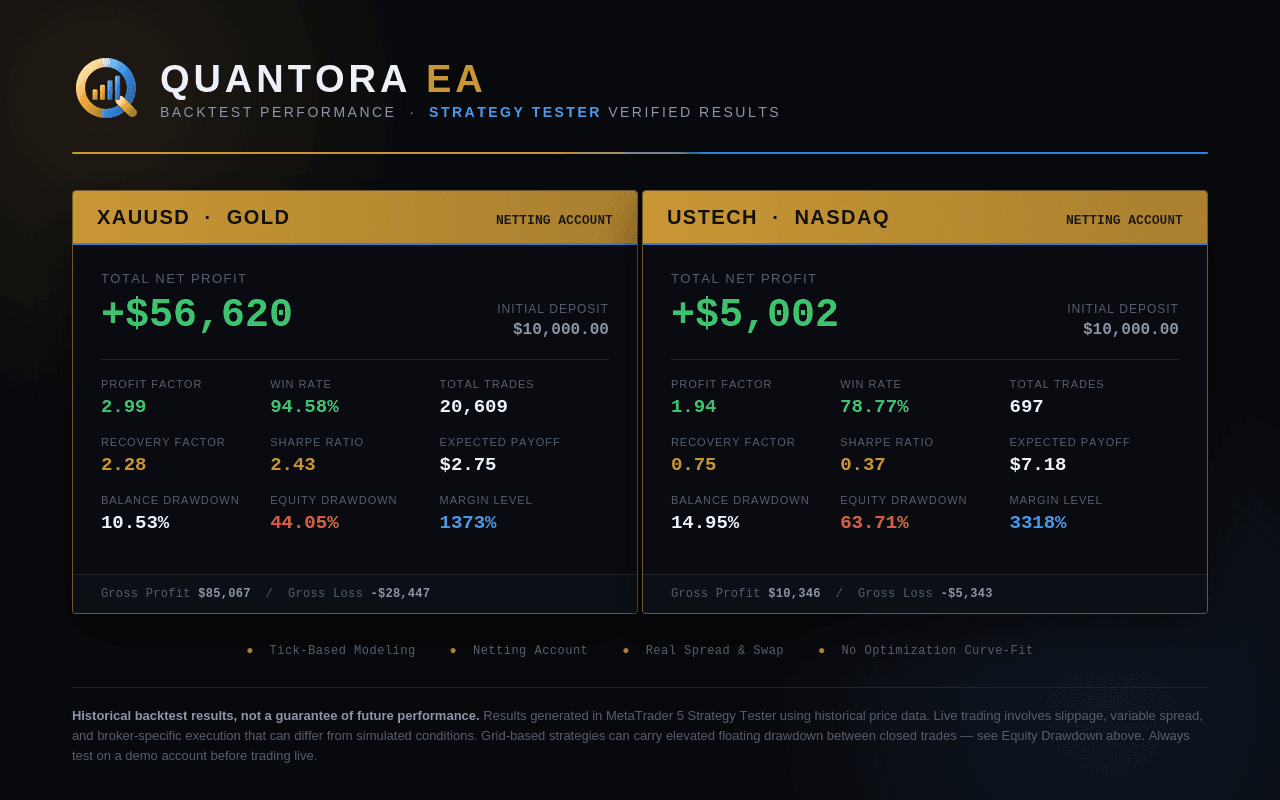
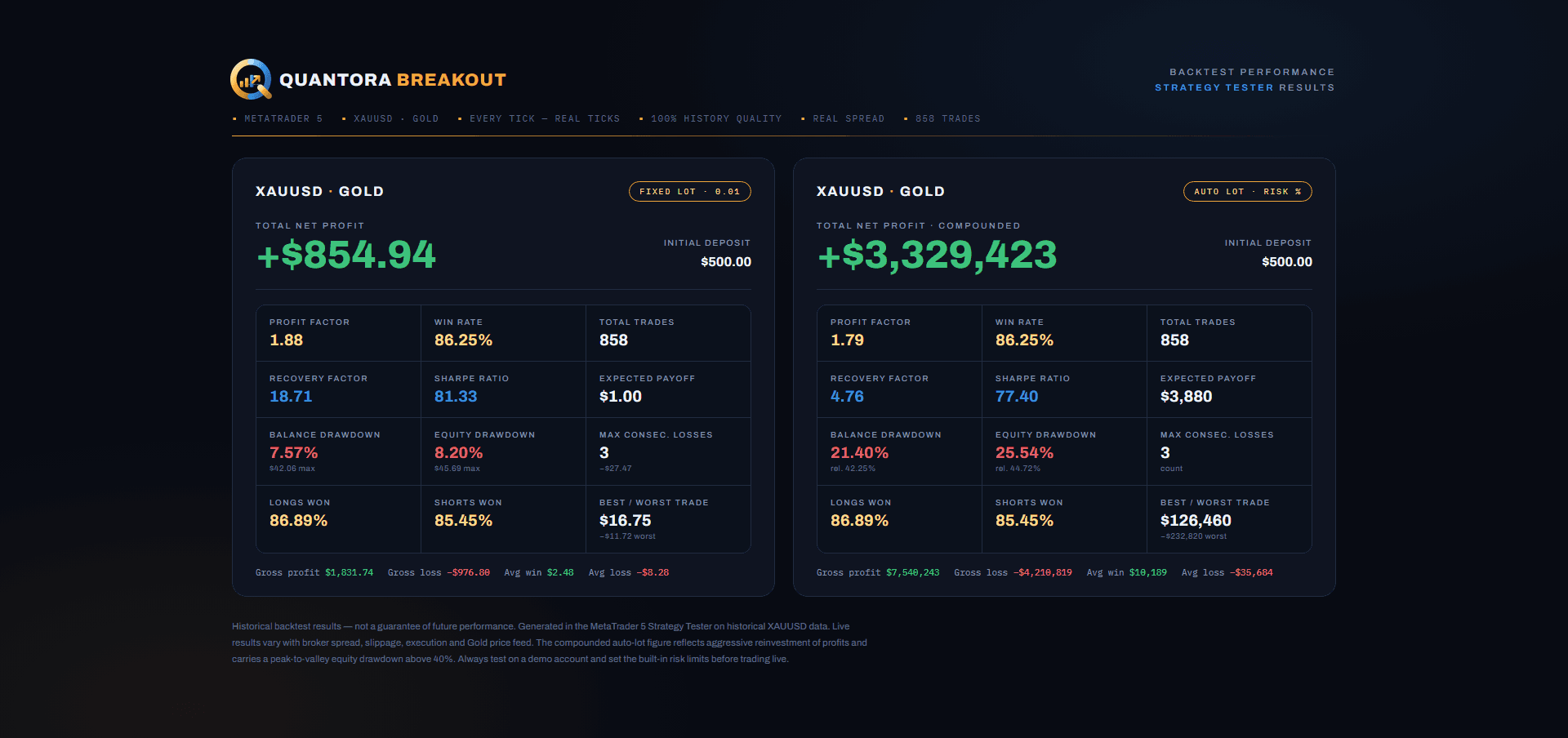
A Strategy Tester report is a controlled experiment; a live account is the weather. Both are useful and both are routinely misread. Sellers show the backtest because it's smooth; buyers should read the live account because it's true. Here's exactly why the two diverge, so you can judge each for what it is.
1. Tick modelling
MT5 can test on "Every tick based on real ticks" (the broker's recorded ticks), "Every tick" (generated from 1-minute bars), or "1 minute OHLC" (four prices per minute). Grid and scalping EAs that act inside a minute can look completely different across the three. A report that doesn't say which modelling was used, or used OHLC for an intrabar strategy, is optimistic by construction. Real ticks is the only setting that approximates live behaviour, and even that is one broker's ticks on one day.
2. Spread
The tester applies either the current spread or a fixed one. Gold's live spread varies from 10 cents to several dollars during news. A backtest at a fixed 15-cent spread never experiences the 300-cent minute that stops out a live position or fills a pending order $2 away. Ask what spread the report used; a fair test uses the broker's real ticks or a pessimistic fixed spread.
3. Slippage and execution
MT5's No Delay mode tests idealised execution, while fixed or random delay can model price changes between a request and execution. Record the delay setting in the report and test sensitivity to it. These simulations do not reproduce every live fill, liquidity constraint or broker condition; execution differences can affect both entries and exits.
4. Swap and commission
Swap (the overnight financing charge) is applied in tests only if the symbol's specification carries it, and commission only if configured. A grid that holds baskets for days pays real swap every night; on Gold it's meaningful, on stock CFDs it's decisive. If the report's "Commission" and "Swap" lines read zero for a multi-day strategy, the net profit is overstated.
5. Over-optimisation
Optimise enough parameters on enough history and you can make almost any strategy look perfect on that history. The signs: a smooth backtest with no losing months, inputs like "RSI 37.4" instead of round numbers, and a live account that starts rough immediately. A fair backtest uses default or round inputs and leaves an out-of-sample period untouched.
6. The live account is small and short
Live accounts have their own bias: they're young. A backtest covers five years and 20,000 trades; the live account covers four months and 400. Early live results — good or bad — are noisier than the backtest, and the honest comparison is the shape (win rate, average win/loss, drawdown per trade) rather than the total return.
How to read them together
- Use the backtest to understand the strategy's character: how often it trades, how deep its baskets go, what a losing streak looks like.
- Use the live account to check whether that character survives real spreads and execution — do the profit factor and win rate rhyme with the backtest?
- Distrust a backtest with no modelling, spread or swap details, and a live account with no Myfxbook verification.
- Do not assume a fixed percentage difference between backtest and live returns. Compare equivalent settings, costs and periods, then investigate the actual differences in trades and execution.
What Quantora publishes
Quantora product pages present the evidence available for that product. Historical backtest reports and screenshots should be read separately from a linked Myfxbook account. Quantora Breakout currently presents historical backtest evidence; do not treat that as a live trading record.
Products with configured Myfxbook accounts can show provider figures refreshed by the daily sync. A failed refresh can leave cached or fallback figures, so check timestamps and the original provider page before making comparisons.