A grid strategy places entries according to defined price intervals and manages some or all of them as a basket. It can close profitable baskets in ranging conditions while accumulating open losses during a persistent adverse trend. The word grid does not establish whether volume is fixed, increases linearly or multiplies; those are separate risk decisions.
The central question is what happens when price keeps moving away from the first entry without a useful reversal. Wider spacing, a lower average entry and more margin capacity do not make that sequence safe. The example below is deliberately fictional and does not describe Quantora's trading results or recommended settings.
Fixed and adaptive spacing change entry timing
A fixed grid uses a stated price or percentage interval. An adaptive grid changes that interval using a defined measure such as volatility. Wider spacing can slow the addition of positions during a larger move, but its effect depends on the full rule and the existing basket.
Percentage spacing is often easier to compare across differently priced stocks than one fixed price-distance input. Verify whether an EA input means points, pips, price units or percentages. Neither fixed nor adaptive spacing determines the maximum cash loss unless volume, number of entries and exits are also bounded and their execution is understood.
A worked buy basket through a sustained decline
Assume a fictional linear instrument where each unit held gains or loses one dollar for each dollar of price movement. Buy one unit at 100, two at 90 and three at 80. At a price of 70, their separate price-distance losses are $30, $40 and $30, totaling $100 before charges.
Total volume is six units. The weighted average entry is (100 × 1 + 90 × 2 + 80 × 3) divided by 6 = 86.6667. Lowering the average entry from 100 has not removed the $100 open loss. A further decline from 70 to 60 adds $60 of loss to the same six-unit basket, making the total $160 before costs.
| Entry | Units | Open loss |
|---|---|---|
| 100 | 1 | −$30 |
| 90 | 2 | −$40 |
| 80 | 3 | −$30 |
| Total | 6 | −$100 |
A recovery level is conditional, not a forecast
Without costs, that basket breaks even at approximately 86.6667. If closing all six units would require an assumed $12 of accumulated financing and other charges, the break-even price becomes 88.6667: two extra price units across six units are needed to offset the $12.
Price is not obliged to revisit either level. If another entry is added, both total volume and the weighted price change again. An EA target adjusted for swap can account for a recorded cost but cannot ensure a reversal, stop charges growing or keep the account solvent until the target becomes executable.
Lot progression and correlated baskets magnify exposure
Compare one, two and three units with one, two and four units: the second schedule already holds seven rather than six after only three entries. Further multiplying entries grows exposure much faster. A maximum-level count is useful only when the corresponding cumulative volume and account effect are calculated.
Several buy grids in related stocks or instruments can lose together in the same selloff. Different symbols are not automatic diversification. Inspect common sector, index, currency and market exposure, and stress the account with simultaneous adverse moves rather than testing each basket as though it were the only one open.
Margin and protective exits need separate review
For a hypothetical $1,000 starting equity and only the six-unit example's $100 open loss, equity would be $900 before charges. Margin requirements depend on the actual contract and account; the arithmetic alone cannot tell you whether new entries are permitted or liquidation occurs.
Identify whether a basket stop is an actual server order or a local EA rule. A local rule depends on the terminal and connection, and any close request can encounter slippage, a gap or rejection. An optional stop that is disabled in the chosen preset provides no active limit. Confirm the accepted protections and behavior on demo, including restarts.
Review evidence across losing regimes
- Save spacing units, volatility settings, cumulative volume schedule, maximum positions and the exact exit rule.
- Include sustained trends, gaps and periods with increasing financing, not only selected ranging months.
- Measure equity drawdown and time underwater alongside closed profit and win rate.
- Count concurrent baskets and correlated instruments when reviewing total exposure.
- Use the intended contract, account model, commission, financing and execution assumptions in tests.
- Keep untouched forward evidence and losses. A smooth balance line can conceal open basket risk.
Where Quantora's documented grids fit
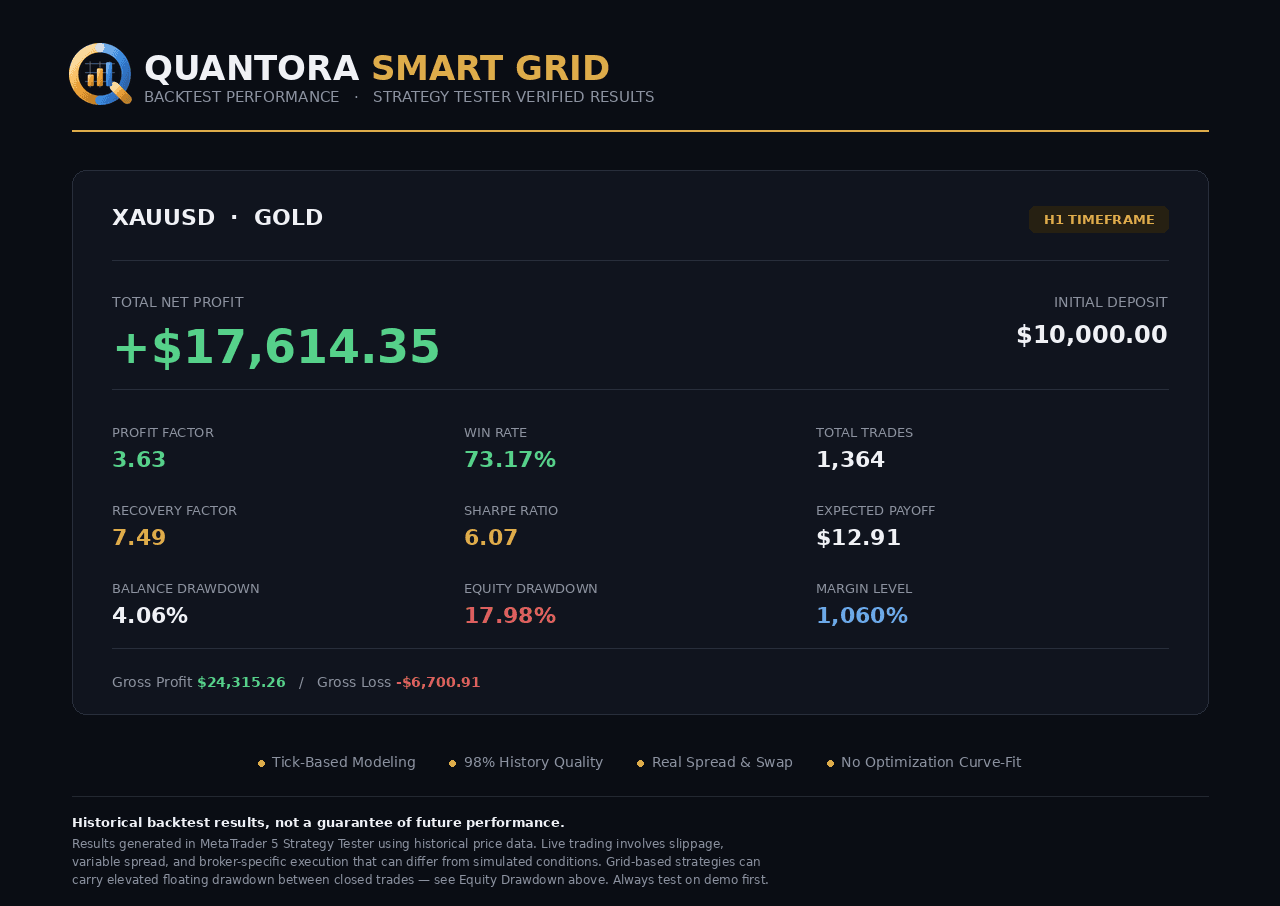
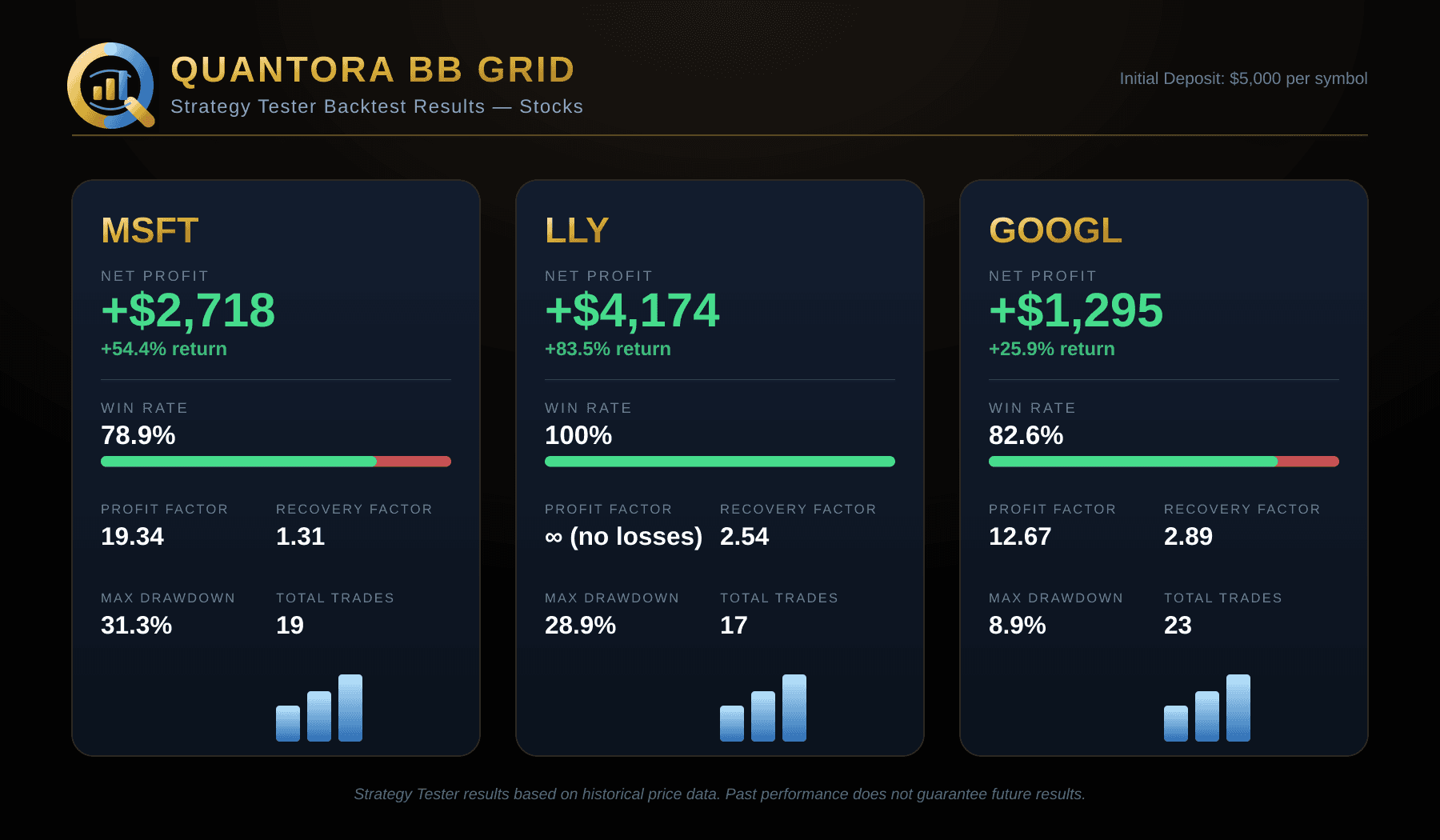
Quantora Smart Grid MT5 is documented as a buy-only adaptive XAUUSD grid with configurable basket controls. Quantora BB Grid MT5 applies grid logic to stocks and stock CFDs using percentage settings and documented account requirements. Their product pages describe different sizing, progression and operating inputs.
Review those current documents, enabled presets and linked source records rather than inferring protection or performance from this general example. Historical backtests and live records are different evidence, and neither establishes a future maximum loss. A grid label and a low starting lot are not a complete risk specification.
Common questions
- Does averaging down eliminate an open loss? No. It changes the weighted entry and increases quantity; an ongoing decline affects the entire enlarged basket.
- Is every grid martingale? No. Fixed, additive and multiplying volume schedules have different exposure, and must be inspected separately.
- Does more leverage solve a strong downtrend? It may permit more collateral-supported exposure but does not reduce the loss on the same position.
- Does a basket stop guarantee its stated cash loss? No. Implementation, connectivity, costs and the eventual fill can alter the outcome.