"Minimum deposit $100" on a broker page and "recommended deposit $5,000" on an EA page are answering different questions. The broker is telling you the smallest amount it will accept. The EA seller is telling you how much cushion the strategy historically needed to survive its own drawdown at a sensible lot size. Get the second number wrong and a perfectly good robot blows the account during a routine bad week — not because it failed, but because it never had room to work.
Start with Gold's contract size
One standard lot of XAUUSD is 100 troy ounces. A $1 move in the Gold price is therefore $100 per lot, $10 per 0.1 lot, and $1 per 0.01 lot. Gold routinely moves $30–60 in a day and $100+ on a big news event. At 0.01 lots that is $30–100 of floating swing on a single position; a grid holding six positions feels that six times over.
Margin is separate from drawdown. At $4,000 an ounce a 0.01-lot position controls $4,000 of Gold: about $8 of margin at 1:500 leverage, $133 at 1:30. Margin is rarely what kills an account. Floating drawdown is.
The formula
Deposit needed = (worst historical drawdown in dollars at your lot size) ÷ (the fraction of the account you are willing to see underwater). Two inputs, both knowable. The first comes from the EA's live Myfxbook record or a real-tick backtest, scaled to the lot size you will run. The second is your own tolerance — 30% is aggressive, 20% is sane, 10% is conservative.
Example: an EA's live account shows a maximum drawdown of $900 running 0.01 lots per grid level. At a 30% tolerance, the deposit is $900 ÷ 0.30 = $3,000. At 20% it is $4,500. If you want to run 0.02 lots, double the drawdown figure first.
Worked example: a buy-only Gold grid
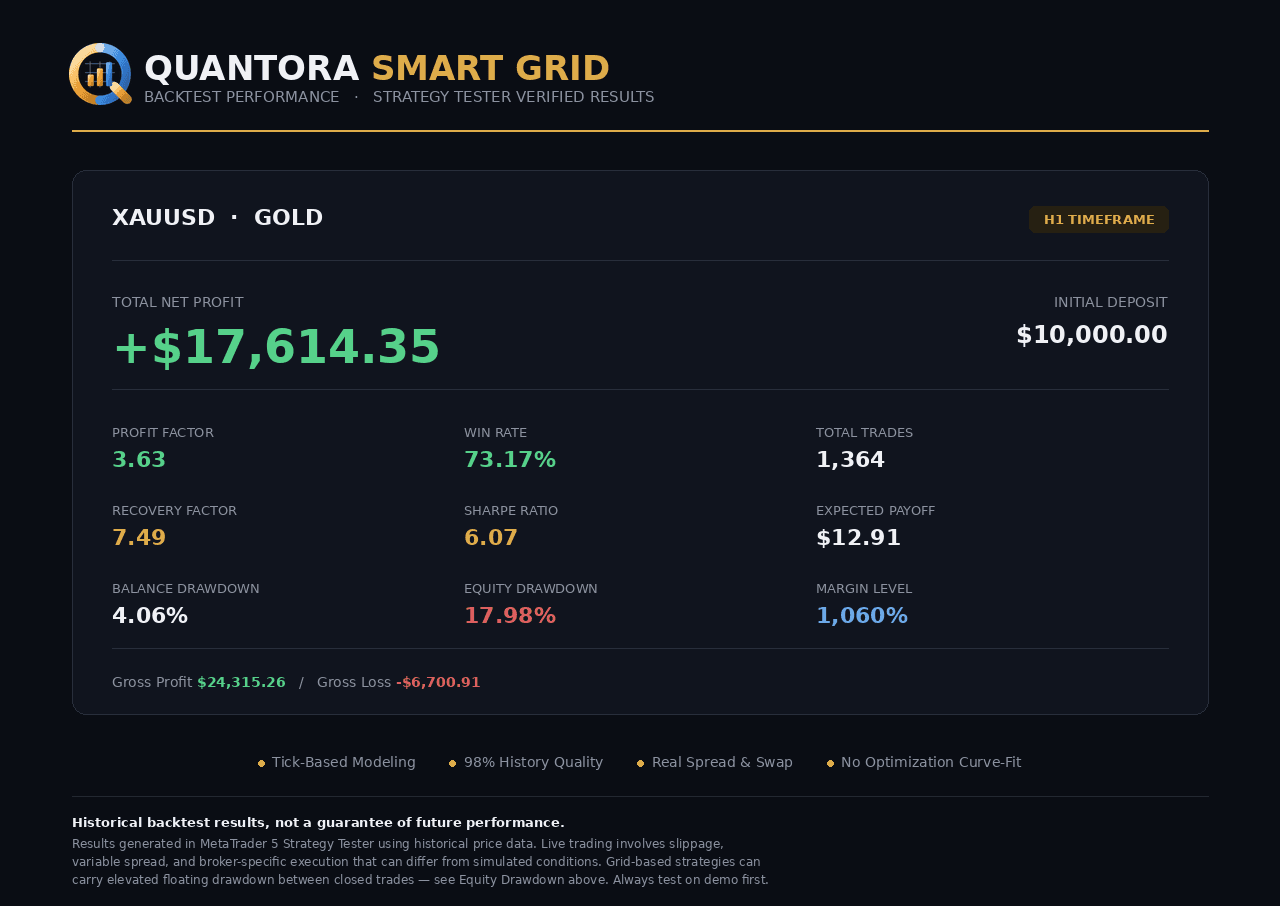
Quantora Smart Grid's public account (a cent account, so figures are in US cents) has run hundreds of trades with a maximum drawdown under 3% — but that percentage is relative to the deposit it runs on with its default lot settings. The setup guide states a $5,000 recommended deposit for those defaults. Halve the deposit and the same drawdown becomes 6%; quarter it and a normal bad week is a 12% dip, and the first abnormal one is a margin call.
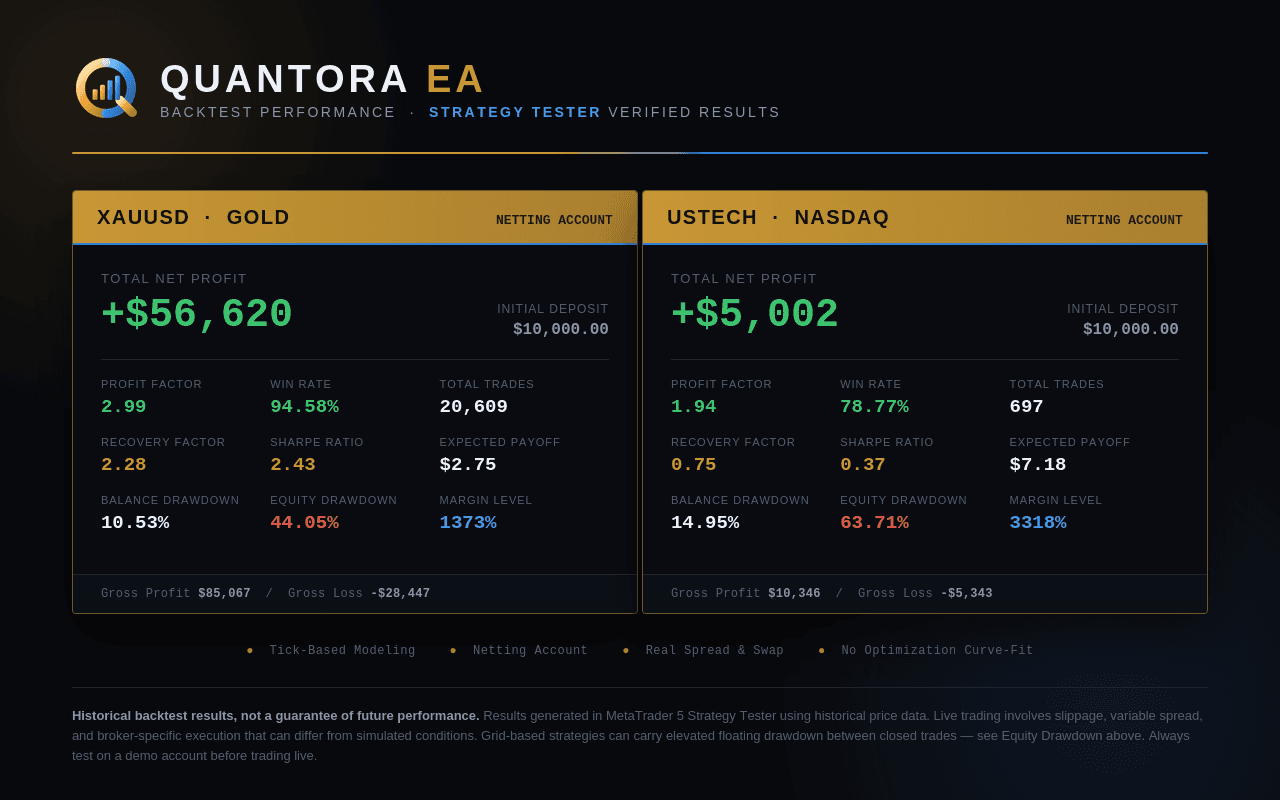
Quantora EA on Gold and indices has a very different profile: a live maximum drawdown around 32%. Its guide recommends $5,000–10,000 for Gold precisely because the strategy carries deeper baskets. Same seller, same platform, three-times-different deposit — because the drawdown is three-times-different.
Cent accounts: the honest way to start small
A cent account denominates balance in US cents: a $50 deposit shows as 5,000 USC, and 0.01 lots means 0.01 cent-lots — one hundredth of the standard exposure. You get real execution, real spreads and real slippage, at stakes where a 30% drawdown is $15. It is how Quantora's own Gold accounts are tracked publicly. If the recommended deposit is out of reach, a cent account with the same inputs is a far better plan than a standard account with the lots cut so small the EA can't open its grid.
What not to do
- Don't size from the backtest's balance curve. Use the equity drawdown (open positions included) — on a grid the two differ by a lot.
- Don't size from the average drawdown. The maximum is the one that will visit you, usually at the worst time.
- Don't "start with $500 and add later". Grids need the cushion on day one; adding after a drawdown is how martingale-style losses happen.
- Don't run two grid EAs on one account without adding their drawdowns together. Gold and NAS100 fall on the same days.
Sanity-check before going live
- Read the maximum drawdown on the live Myfxbook page, not the marketing page.
- Note the lot size that account runs (Info tab → trades) and the deposit it started with.
- Scale to your lot size and apply the formula above. If the answer is more than you have, reduce the lot size or use a cent account — never the tolerance.