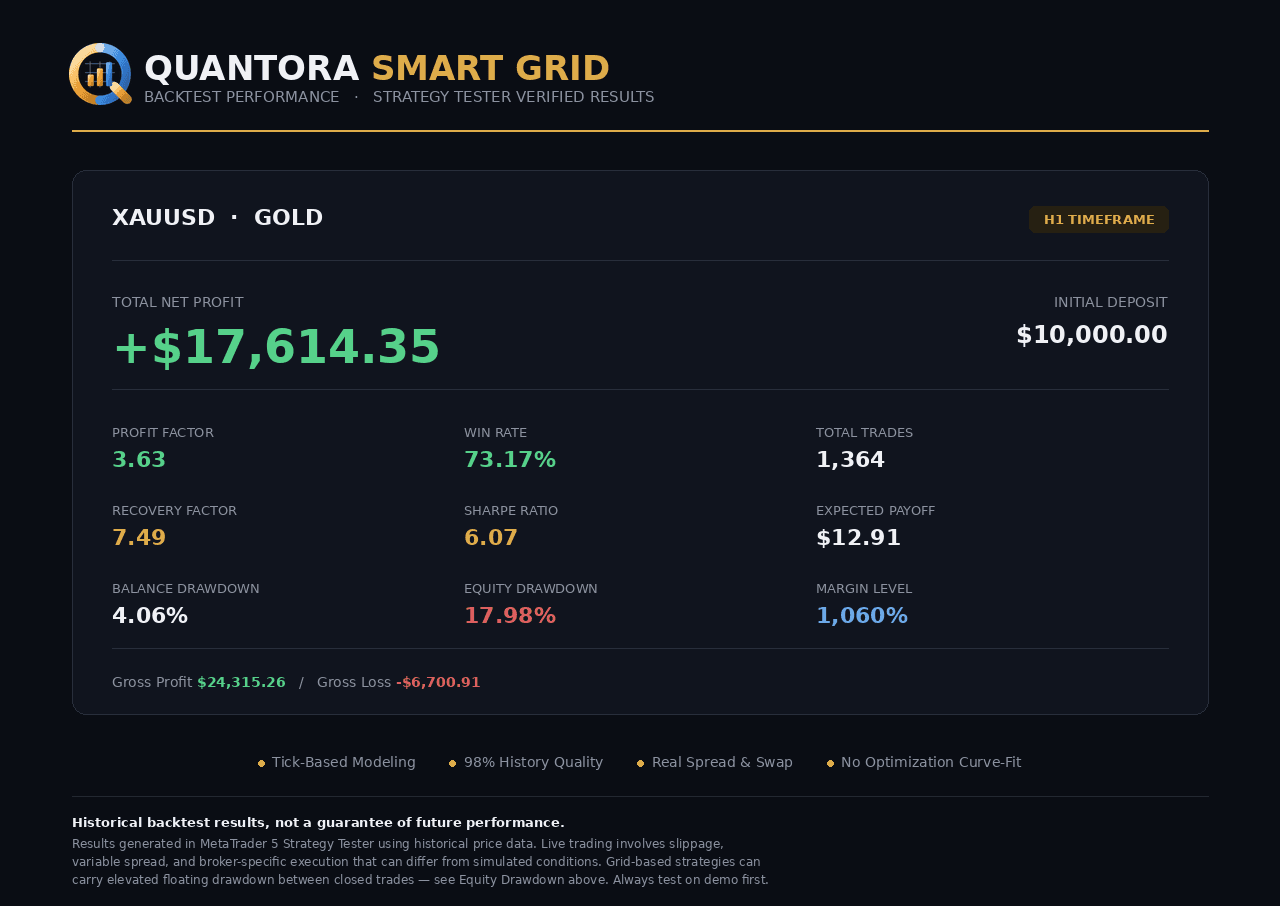
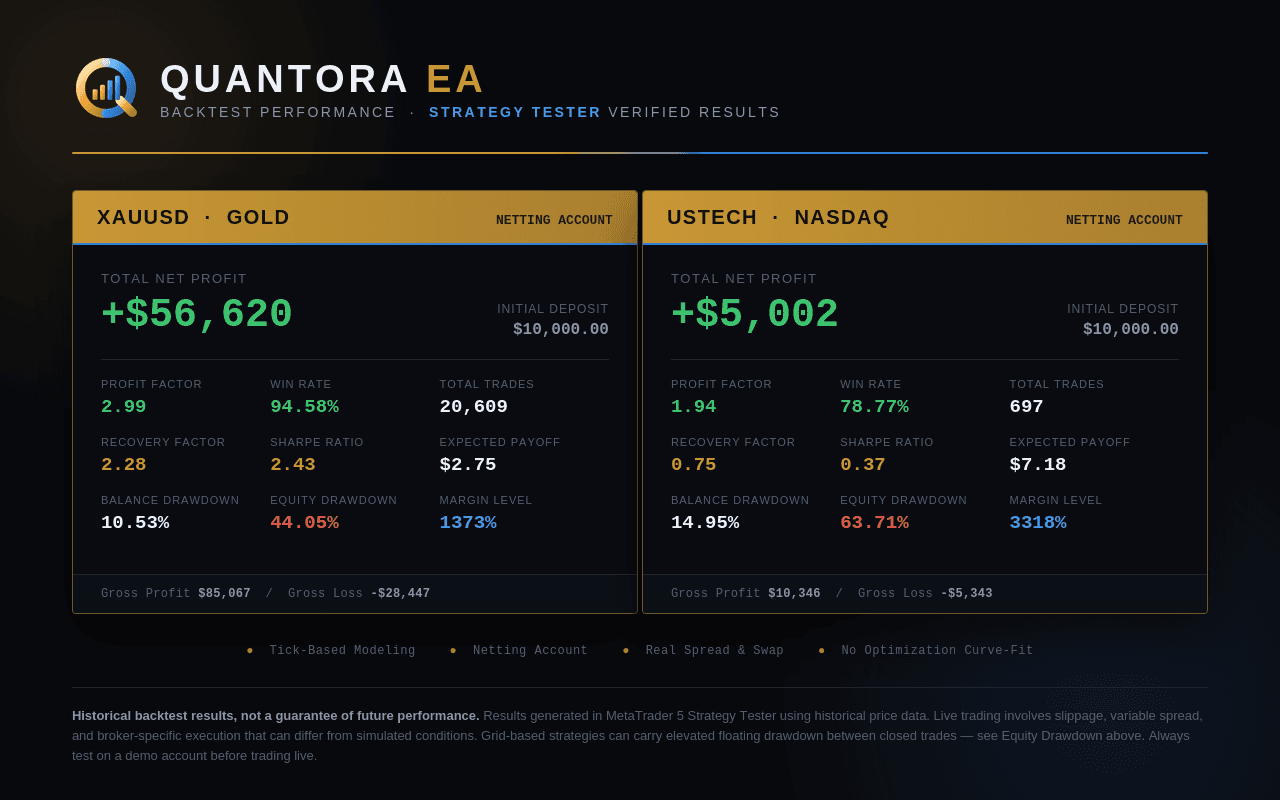
Two people run the same Gold EA with the same inputs. One makes 4% a month, the other loses. The difference is often the broker: a 35-point spread instead of 12 turns a scalping grid's edge negative, a negative swap turns a five-day basket into a slow leak, and 200 ms of execution delay fills breakouts at the wrong price. Here is what to compare — with numbers — before you attach a robot to a live account.
1. Spread: raw plus commission usually wins
Standard accounts fold the broker's fee into a wider spread — 25–45 points on Gold is common. Raw or ECN accounts show the interbank spread (often 8–20 points on Gold in London/New York hours) and charge a commission per lot, typically $5–7 round-turn. For an EA that takes many small trades the raw account is almost always cheaper, and — more important — its spread is closer to what the EA's backtest and live record were built on.
Measure it yourself: watch the Gold spread in Market Watch at 09:00 London, 15:00 New York and 02:00 Asia. The Asia figure is what your EA pays overnight.
2. Swap: the silent cost of grids
Swap is the overnight financing charge on open positions. On Gold it is usually negative for long positions and charged triple on Wednesday nights. A grid that holds a six-level buy basket for a week can pay more in swap than it makes on the first level's take-profit. Compare swap long/short per lot in the symbol specification, and check whether a swap-free (Islamic) account exists and what admin fee replaces it — sometimes it's worse.
3. Execution and slippage
Market execution with no requotes is the minimum. Beyond that, what matters is average slippage on market orders and how stop orders fill during volatility — neither is on the marketing page. Test on a demo for a week and read the Journal: the difference between requested and filled price on each order is your slippage. Then repeat on a small live account, because demo fills are usually kinder.
4. Hedging account, correct contract size, sane stop levels
- MT5 account must be hedging mode for grid and basket EAs — netting merges your levels into one position.
- Contract size 100 oz and minimum lot 0.01 are standard; some brokers offer 0.001 micro-lots on Gold, useful on small deposits.
- Stop level (minimum distance for pending orders and SL/TP) should be small — a 30-point stop level on Gold blocks tight take-profits.
- Trading hours: some brokers close Gold for an hour a day around the New York close; a grid that expects 24-hour trading will behave differently.
5. Leverage and margin
Grids need margin headroom for every level they might open. At 1:500, a ten-level grid at 0.01 lots on $4,000 Gold needs about $80 of margin; at 1:30 (EU/UK retail limits) the same grid needs over $1,300, and a $2,000 account is a margin-call risk before the strategy has done anything wrong. High leverage does not make a strategy riskier — the lot size does — but low leverage can stop a strategy from working at all.
6. Cent accounts for testing
A cent account (balance shown in US cents) gives real execution at one-hundredth of the stakes. It is how Quantora's own Gold accounts are tracked in public, and it is the right place to run a new EA for its first month. Not every broker offers one, and cent accounts sometimes have wider spreads than the same broker's raw account — check before assuming the results transfer.
Regulation and the boring stuff
- A regulator you can name, segregated client funds, and a withdrawal you have actually completed once before scaling up.
- Server location close to your VPS (London or New York for most brokers) — a 5 ms ping instead of 150 ms is measurable in fill quality.
- Symbol naming that won't change under you; brokers that rename XAUUSD to GOLD.x mid-year break every attached chart.
How to test a broker in two weeks
- Week one on demo with the EA's default inputs: record spread at three sessions, swap charged, and slippage per order from the Journal.
- Week two on a cent or minimum live account with identical inputs: compare fills and net result with the demo week.
- Compare both with the EA's public Myfxbook account for the same dates. Same direction and similar size of moves means the broker is compatible; a very different curve means look at spread and swap first.